A beeping or flashing jump starter is trying to tell you something specific — but the exact meaning depends on your brand and model. On one widely used model, a solid red light means reverse polarity, a blinking red light means the internal battery is overheating, and a light that stays off despite a correct connection means the battery voltage is too low to detect. Other brands use similar ideas but different exact patterns, so always check your own manual.
- Jump starters use LED colors, blink patterns, or beeps to signal specific faults — not random malfunctions.
- On one manufacturer’s model, a solid red LED specifically means reverse polarity (clamps connected backward).
- A blinking red LED on that same model means the internal battery is running too hot.
- A ready/Boost light that stays off, even with the clamps connected correctly, usually means the connected battery’s voltage is too low for the unit to detect.
- Specific numbered beep codes circulated online for some other brands could not be independently confirmed from an official source — treat those with caution and check your own manual.
Why Do Jump Starters Beep or Flash in the First Place?
A portable jump starter has internal circuitry that checks several things before and during a jump attempt: whether the clamps are connected the right way around, whether the connected battery’s voltage is within a range it can work with, and whether the unit’s own internal battery is operating within a safe temperature range. When one of those checks fails, the unit needs a way to tell you — hence LED colors, blink patterns, and on some models, beeps.
These signals exist specifically so you don’t have to guess why a jump attempt isn’t working. The challenge is that there’s no single, universal signal standard across brands — a solid red light means something specific on one model and something different on another.

What Do the Signals Mean on a Sourced, Real Example?
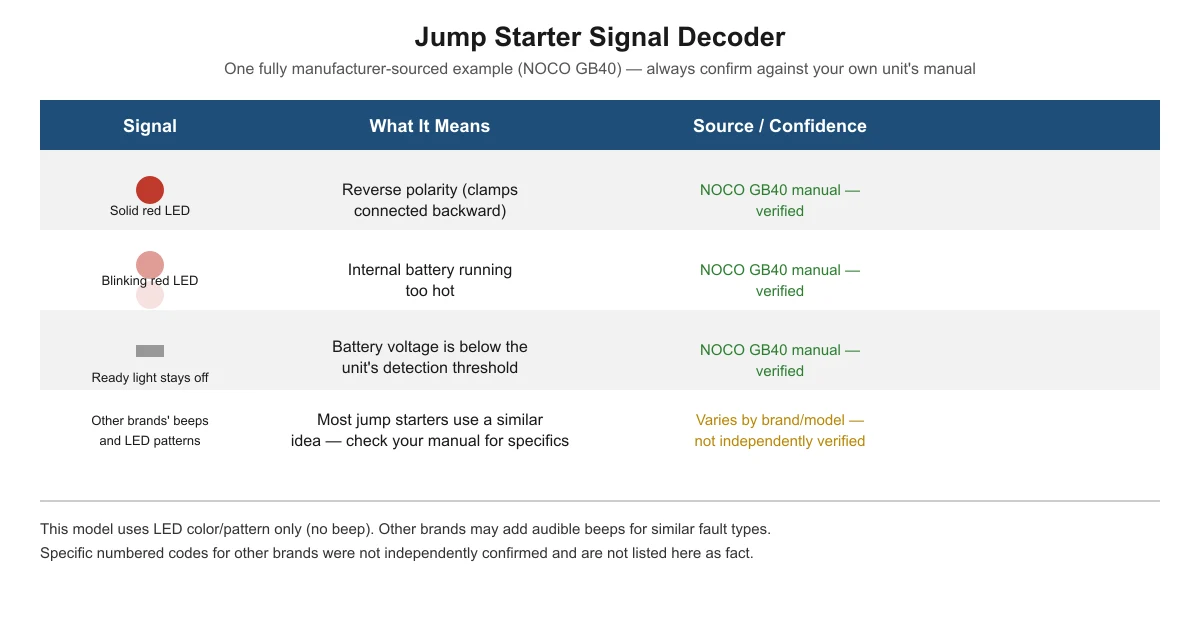
Rather than guess at a universal list, here’s what one widely used lithium jump starter’s official manual documents for its own LED-based signal system (this particular model uses LED color and pattern only, with no beep):
| Signal | What It Means | Source / Confidence |
|---|---|---|
| Solid red LED | Reverse polarity — clamps connected backward | Manufacturer manual — verified |
| Blinking red LED | Internal battery running too hot | Manufacturer manual — verified |
| Ready/Boost light stays off | Connected battery’s voltage is below the unit’s detection threshold | Manufacturer manual — verified |
| Other brands’ beeps and LED patterns | Most jump starters use a similar idea (polarity, overheat, low-voltage signals) — check your manual for the exact meaning on your model | Varies by brand/model — not independently verified here |
Why Can’t This Guide List Exact Codes for Every Brand?
Several brand-specific beep and LED code lists circulate on forums, marketplace listings, and review blogs, but during research for this guide, more than one of those claims couldn’t be traced back to an official manufacturer manual or FAQ page — in at least one case, the brand’s own FAQ page didn’t load at all. Publishing unverified numbered codes as fact risks sending you down the wrong troubleshooting path for your specific unit.
Instead, the reliable approach is: identify the general category your signal falls into (reverse polarity, overheat, low/undetectable battery voltage, or short circuit) using the pattern below, then confirm the exact meaning in your own jump starter’s manual.
How Do I Figure Out What My Signal Means?
Start with these general categories, which hold true across most jump starters even though the exact light pattern differs by brand:
- Reverse polarity: Usually a distinct solid or steady warning color, often red. Double-check and fix your clamp connections — positive to positive, negative to ground or the negative terminal — before trying again.
- Overheat (internal battery or unit): Often a blinking or pulsing pattern. Let the unit cool down in a shaded, ventilated spot before using it again.
- Low or undetectable battery voltage: Often shows as the ready light simply staying off, rather than an active warning — see can a jump starter start a car with a dead battery for what this specifically means and what to do.
- Short circuit (clamps touching each other): Often a distinct alarm-style signal, separate from the reverse-polarity warning. Separate the clamps immediately and recheck your connection.
If your jump starter won’t charge at all, rather than showing a fault signal during a jump attempt, that’s a different problem — see jump starter not charging: step-by-step fixes.
What If the Signal Doesn’t Match Anything Here?
If your unit shows a pattern that doesn’t clearly match reverse polarity, overheating, low voltage, or a short circuit, the most reliable next step is your own jump starter’s printed or digital manual — most manufacturers include a dedicated LED/beep reference table. If you can’t find your manual, check the manufacturer’s official support site directly rather than relying on third-party forum posts or unofficial code lists, since those weren’t reliably verifiable during research for this guide. If the unit still won’t start the car after you’ve addressed the signaled issue, see jump starter won’t start the car for a fuller troubleshooting path.
Safety Notes
Never ignore a reverse-polarity warning and try again without fixing the connection — doing so risks damaging the jump starter, the vehicle’s electronics, or both. If a unit signals overheating, stop using it and let it cool before continuing; using an overheating lithium battery pack isn’t a risk worth taking for convenience. If you ever see smoke, smell burning, or notice the unit becoming hot to the touch beyond a mild warmth, stop immediately and don’t attempt to use it again until it’s been checked by the manufacturer.
The Occupational Safety and Health Administration (OSHA) lists training yourself to recognize a defective, damaged, or failing lithium-ion battery, and following the manufacturer’s own instructions for charging and use, among the basic ways to control lithium-ion battery hazards — which is exactly what reading your jump starter’s LED signals and manual correctly helps you do.
Frequently Asked Questions
My jump starter beeps but has no LED light explanation in the manual — what do I do?
Check the manufacturer’s official support site or contact their support line directly. Beep-only signal schemes vary significantly by brand, and no single cross-brand reference reliably covers every model’s specific beep pattern.
Does a solid red light always mean reverse polarity?
On at least one manufacturer’s documented model, yes — but this isn’t guaranteed to be universal across every brand. Confirm in your own unit’s manual rather than assuming it matches another brand.
My jump starter’s light just stays off with no warning color at all — is that an error?
On at least one documented model, this specifically means the connected battery’s voltage is below the unit’s detection threshold, not a fault with the jump starter itself.
Can I keep trying to jump the car if I get an overheat warning?
No — let the unit cool down first. Continuing to use a lithium battery pack after an overheat warning isn’t a risk worth taking, per general safe-handling practice for lithium battery devices.
Why don’t you list the exact beep codes for my specific brand?
Several brand-specific code lists found during research for this guide couldn’t be confirmed against an official manufacturer source. Rather than publish unverified codes, this guide points you to the general fault categories and your own manual for exact confirmation.
Sources
- NOCO GB40 Official User Guide (LED-based error signal table: reverse polarity, overheat, low-voltage detection)
- OSHA, Lithium-ion Battery Safety — Control Measures (recognizing a defective, damaged, or failing lithium-ion battery; following manufacturer charging/use instructions)
By jumpstarterguides.com Editorial Team. Last updated: November 13, 2026.