When a jump starter won’t start the car, the cause is either on the device side (low charge, poor clamp contact, or a safety lockout) or the vehicle side (corroded terminals, a sulfated or dead battery, or a failed starter motor). Check the jump starter’s own light or beep first — it’s usually telling you something specific — then move to the vehicle if the device itself looks normal.
- A solid red error light on most units means the clamps are reversed; a blinking red light usually means the unit’s internal battery is too hot to deliver a jump right now.
- If the ready light never comes on at all, the vehicle’s battery voltage may be below what the jump starter can detect.
- Corroded terminals, a sulfated battery, and a failed starter motor are the three most common vehicle-side causes, and none of them is something the jump starter can fix.
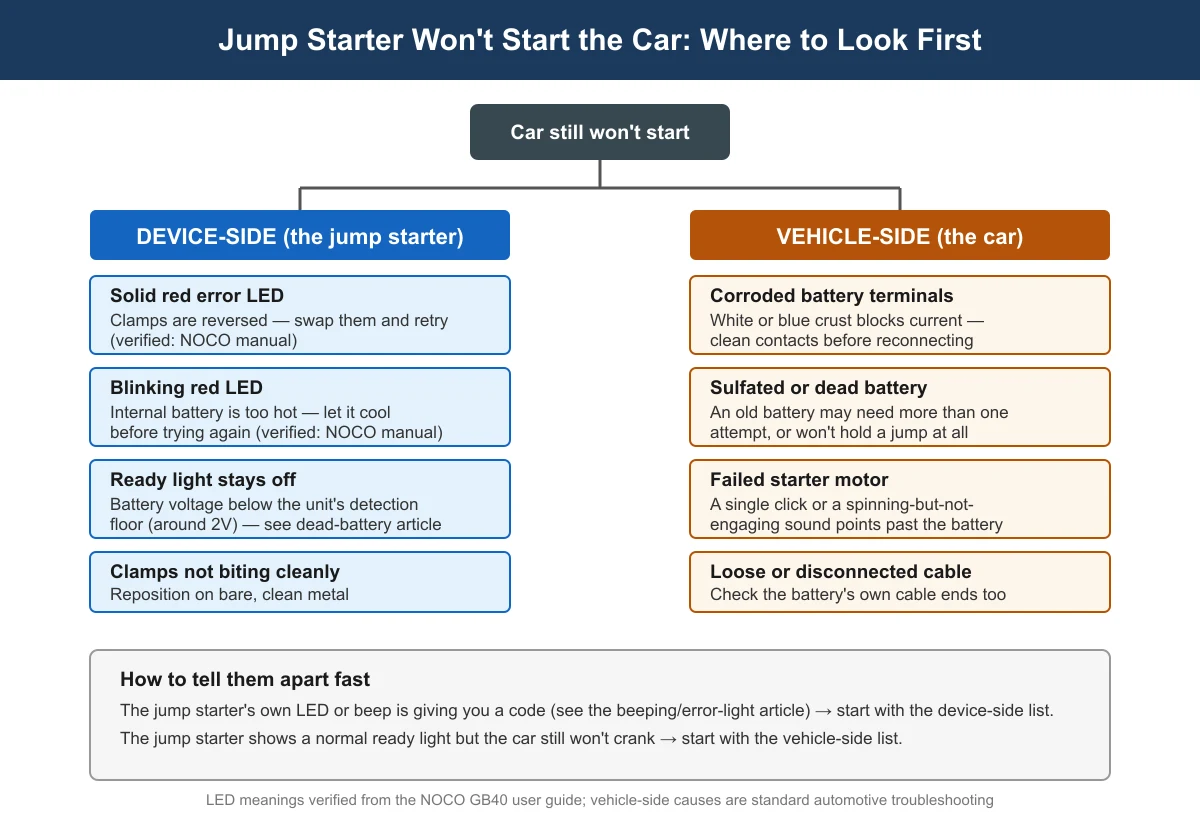
- The decision-tree graphic below separates these two categories so you check the right side first.
Start With the Jump Starter’s Own Signal
Most portable jump starters communicate a problem through an LED or a beep before you even try to crank the engine. On the NOCO GB40, for example, a solid red error light specifically means the clamps are connected backwards — swap them and try again. A blinking red light means the unit’s internal battery has gotten too hot to safely deliver a jump; give it time to cool before retrying. If the ready or “boost” light never illuminates despite a correct connection, the detected battery voltage is likely below the unit’s minimum detection threshold, which is a different and more specific problem covered in our guide to jump-starting a completely dead, 0-volt battery.
If your jump starter uses a different beep or light pattern than the examples above, check our guide to jump starter beeps and error lights for how to read it, since exact codes vary by brand and model.
Is It the Jump Starter? Device-Side Causes
| Symptom | Likely cause | What to do |
|---|---|---|
| Solid red error light | Reversed polarity (clamps swapped) | Disconnect in the correct order, swap the clamps, reconnect correctly |
| Blinking red light | Internal battery overheated | Let the unit cool before trying again |
| Ready light never turns on | Battery voltage below the unit’s detection floor | See our dead, 0-volt battery guide for next steps |
| Clamps feel loose or slip off | Corrosion or paint on the clamp contact point | Reposition on clean, bare metal |
| Unit worked yesterday, dead today | Jump starter itself needs a recharge | See our not-charging and won’t-hold-a-charge guides |
Low charge is the single most common device-side reason a jump starter doesn’t deliver enough current to crank an engine, especially a larger one. If this looks like your situation, our guides to a jump starter that won’t charge and a jump starter that won’t hold a charge cover the two different versions of that problem.
Is It the Car? Vehicle-Side Causes
These three causes are standard automotive troubleshooting, not specific to any jump starter brand, and a jump starter can’t fix any of them on its own:
- Corroded battery terminals. A white or bluish crust on the terminals blocks current even with a perfectly good clamp connection. Midtronics, a maker of automotive battery-diagnostic equipment, notes that corroded terminals add resistance that can make a perfectly healthy battery test weak — which is why cleaning the terminals (with the jump starter disconnected) and trying again comes before assuming the battery itself has failed.
- A sulfated or internally failed battery. An older battery that’s been deeply discharged repeatedly may accept a jump on one attempt and die again in minutes, or not take a jump at all. This is a battery problem, not a jump-starter problem.
- A failed starter motor. If you hear a single click, or the engine cranks but sounds like it’s spinning without engaging, the issue is likely downstream of the battery entirely, in the starter motor or its solenoid. Midtronics points out that a failing starter can itself draw excess current and drag battery voltage down, which is one reason a battery can look weak even when it’s actually fine.
How Do You Tell the Two Apart Quickly?
The fastest filter is the jump starter’s own indicator. If it’s showing an error code of any kind — a specific color, a blink pattern, or a beep — start with the device-side list, since the unit is actively telling you something. If the jump starter shows a normal, correctly-connected ready signal and the car still won’t crank, or cranks weakly and dies, move to the vehicle-side list. A multimeter reading at the battery terminals (if you have one) can help confirm which side the voltage drop is coming from, though you don’t need one to work through the checklist above. For a definitive answer, Midtronics recommends a shop test that checks the battery, starter, and alternator together in one sequence, since corrosion or a failing starter can each make a healthy battery look weak on its own.
What If You’ve Already Followed the Connection Steps Correctly?
If you’re not sure your clamp order or ground point was correct to begin with, go back to our step-by-step guide to using a jump starter correctly before troubleshooting further — a loose or misplaced ground clamp can look exactly like a dead jump starter or a dead battery when the real issue is just an incomplete connection.
Mistakes That Make Diagnosis Harder
- Repeating the same failed attempt over and over. If the first two or three tries fail the same way, the fix is almost never “try it again exactly the same way” — go back to the device-side or vehicle-side checklist instead.
- Assuming a full charge means the jump starter is fine. A fully charged unit with a loose or corroded clamp contact can still fail to deliver enough current, which looks identical to a low-charge failure from the driver’s seat.
- Skipping the ground-point check. A ground clamp that’s resting on paint, plastic, or a loose bracket instead of bare metal can prevent a complete circuit even when every other step was done correctly.
- Ignoring an overheat warning. If the unit shows a blinking overheat light, forcing another attempt right away typically won’t help and may just extend the cooldown you were waiting on in the first place.
Frequently Asked Questions
My jump starter shows full charge but the car still won’t start. What’s wrong?
A full charge rules out the most common device-side cause, so check the vehicle-side list next: corroded terminals, a battery that won’t hold a jump, or a failed starter motor. Also confirm the clamps are making solid contact with clean, bare metal on both the battery and the ground point.
Why does my jump starter work on one car but not another?
This usually points to the vehicle, not the device — different batteries age differently, and a battery that’s more deeply discharged or more heavily sulfated needs more help than a healthy one. Corroded terminals on one vehicle but not the other are another common explanation.
Can a weak jump starter connection look like a dead battery?
Yes. Clamps that aren’t biting into clean, bare metal can mimic a dead battery or a non-functioning jump starter. Always check that both clamp contact points are clean and tight before assuming a bigger problem.
Should I try jumping the car more than once if it doesn’t work the first time?
A few attempts are normal, especially for an older or more deeply discharged battery. If repeated attempts all fail the same way, that’s a sign to move from the device-side checks to the vehicle-side checks rather than continuing to try the same connection again.
Sources
- NOCO, GB40 Boost Plus User Guide and Warranty (manufacturer manual) — LED error meanings (reversed polarity, overheat) and the battery-voltage detection floor.
- Midtronics, “Symptoms That Can Look Like a Bad Battery (But Might Not Be)” — corroded terminals and a failing starter can each make a healthy battery test weak, and a combined battery/starter/alternator test tells them apart.
By jumpstarterguides.com Editorial Team. Last updated: November 13, 2026.