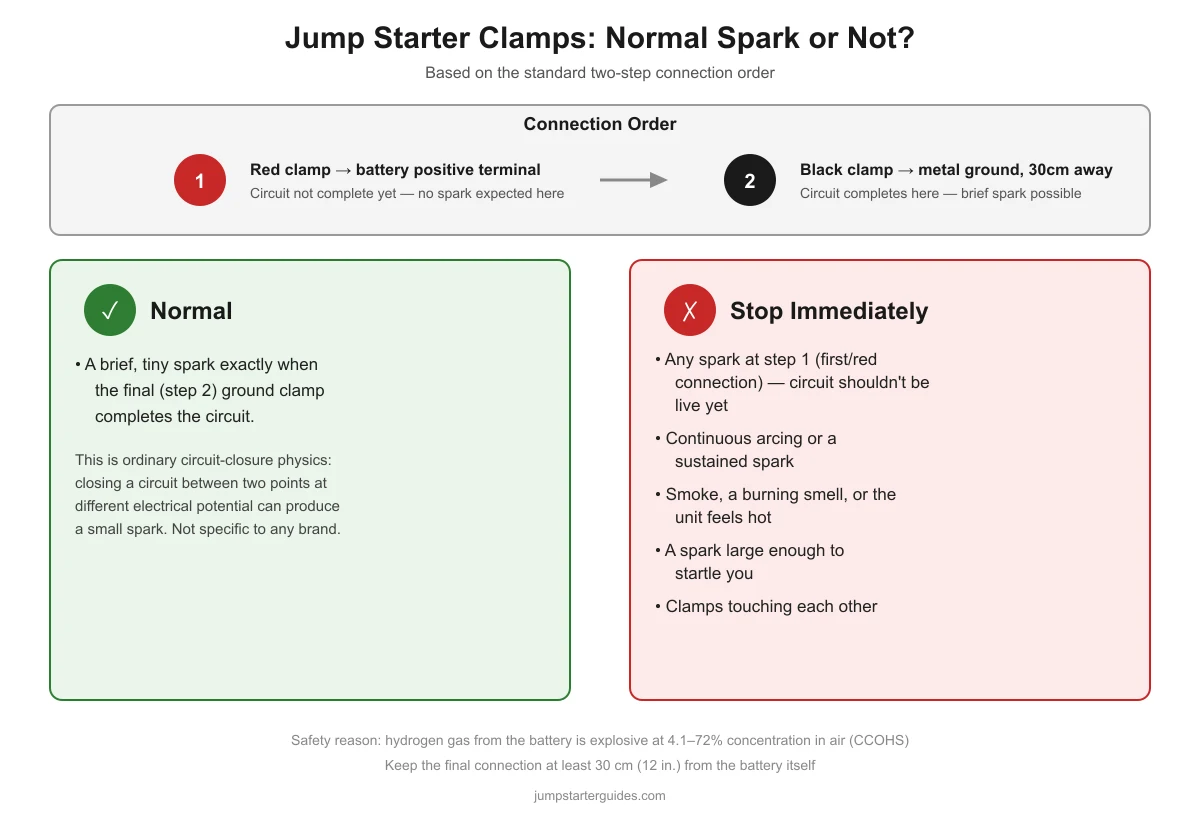
A brief, tiny spark exactly when you finish connecting the clamps is ordinary circuit-closure physics, not a malfunction. What’s not normal: a spark when you attach the first (positive) clamp, continuous arcing, smoke, a burning smell, or a spark big enough to startle you. Any of those means stop immediately, disconnect, and recheck your connections before trying again.
- A battery under charge or load gives off hydrogen gas, which is explosive in the right concentration — this is the real safety reason behind clamp order and spark precautions, not superstition.
- Connect positive (red) to the battery’s positive terminal first; connect negative (black) to an exposed, unpainted metal ground point last. Disconnect in reverse order.
- A small spark only when that last, ground connection completes the circuit is consistent with normal electrical behavior.
- Sparking when you make the first connection, before the circuit should be live at all, points to a wiring mistake — stop and recheck.
- Keep that final connection point at least 30 cm (12 inches) away from the battery itself, and never let the clamps touch each other.
Why Jump Starter Clamps Can Spark at All
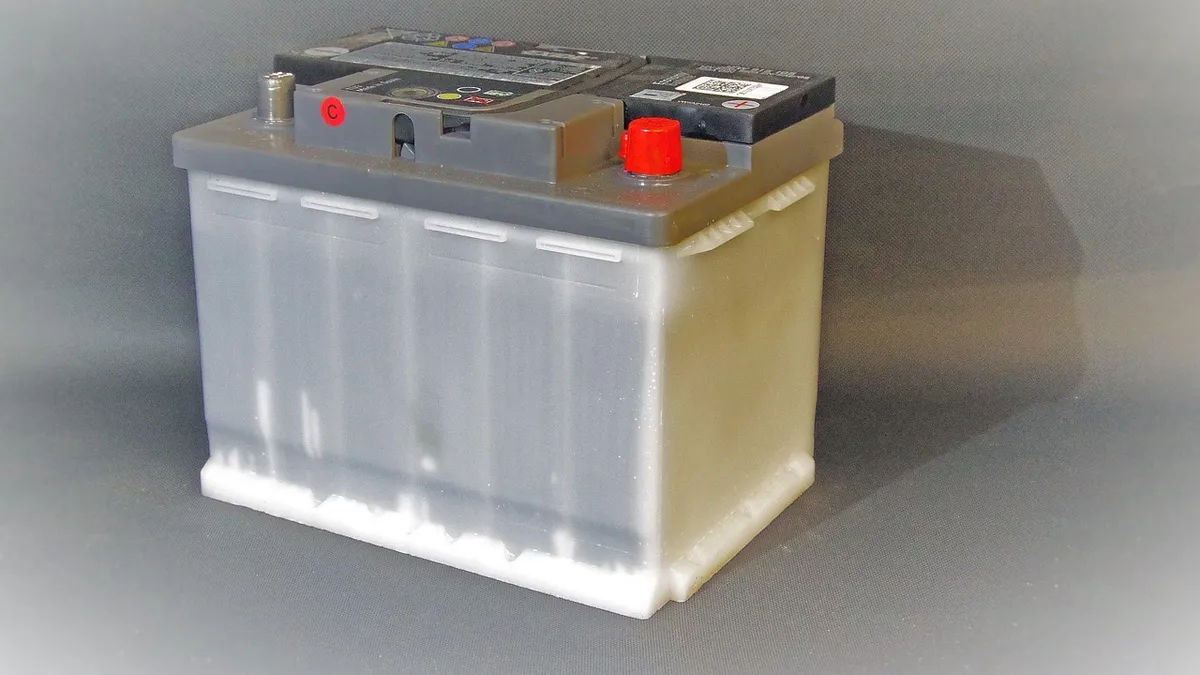
Any lead-acid car battery gives off hydrogen gas as a normal byproduct of charging and discharging, including while it’s being jump-started. According to the Canadian Centre for Occupational Health and Safety (CCOHS), hydrogen is explosive at concentrations between roughly 4.1% and 72% in air, and sparks from booster or jumper cable clamps are a recognized way to ignite that gas if it has built up around the battery, particularly in a poorly ventilated space.
That’s the real reason clamp order and spark awareness matter: not because any spark is automatically dangerous, but because a spark in the wrong place, at the wrong time, or near a buildup of hydrogen gas is how a bad situation becomes a genuinely dangerous one. CCOHS’s guidance is specifically to make the final clamp connection at least 30 cm (12 inches) away from the dead battery, which keeps any spark from that connection well clear of where hydrogen gas is most concentrated.

The Correct Connection Order (and Why It’s in That Order)
Our full step-by-step guide to using a jump starter correctly covers this in more detail, but the order matters enough to repeat here because it’s the entire basis for what counts as a “normal” spark. For a portable jump starter (not jumper cables between two cars), there are two clamps to connect, in this order:
- Positive (red) clamp → the dead battery’s positive terminal. At this point, only one side of the circuit is connected. Nothing should spark here under normal conditions, because the circuit isn’t complete yet.
- Negative (black) clamp → an exposed, unpainted metal ground point on the vehicle’s frame or engine block, at least 30 cm (12 inches) from the battery — or the battery’s negative terminal if your jump starter’s manual specifies that instead. This is the connection that completes the circuit.
Disconnect in the reverse order: negative/ground clamp off first, then positive clamp off last. This order isn’t arbitrary tradition; it’s built around keeping the circuit open until the final connection is made away from the battery itself, and breaking it the same way in reverse.
Normal Spark vs. Stop Immediately: The Checklist
Completing an electrical circuit between two points at different electrical potential can produce a small, brief spark — that’s basic circuit-closure physics, true of electrical connections in general, not a special property of any one brand of jump starter. Because of the connection order above, that moment happens specifically at step 2, the final ground connection. Here’s the full breakdown as a graphic, followed by the same information in a table.
| What you see | Normal or not? | What it likely means |
|---|---|---|
| Tiny spark only at step 2 (final ground connection) | Normal | Ordinary circuit-closure physics as the connection completes. |
| Any spark at step 1 (first, positive connection) | Not normal | The circuit shouldn’t be live yet; check for a wiring fault or a clamp touching something it shouldn’t. |
| Continuous arcing or a sustained spark | Not normal | Likely a short circuit or a loose/damaged clamp; stop and disconnect. |
| Smoke, melting smell, or the unit feels hot | Not normal | Stop immediately, disconnect, and let everything cool before inspecting. |
| A spark large enough to startle you | Not normal | Larger than the brief circuit-closure spark; recheck polarity and connections before continuing. |
What Causes an Abnormal Spark
The most common cause of sparking where it shouldn’t happen is reverse polarity — connecting positive to negative or vice versa. The NOCO GB40’s official user guide warns that letting the positive and negative clamps touch each other directly creates a short circuit and sparking; this is specifically called out as a wiring-mistake scenario, not a normal part of jumping a car. Many jump starters include reverse-polarity protection that’s designed to prevent the unit from powering the circuit at all in that situation, but that protection isn’t a substitute for connecting the clamps correctly in the first place. Some units have a manual override mode meant for batteries too deeply discharged for normal detection — see our guide on whether a jump starter can revive a completely dead (0V) battery — and that override mode typically disables reverse-polarity protection along with it, which makes careful clamp placement even more important in that specific situation.
A damaged, corroded, or poorly seated clamp can also cause intermittent sparking as the connection makes and breaks contact instead of staying solid. If a clamp looks damaged, has exposed wire, or won’t grip a terminal firmly, treat that as a reason to stop and address the clamp itself rather than a connection order issue.
Safety Precautions Worth Taking Every Time
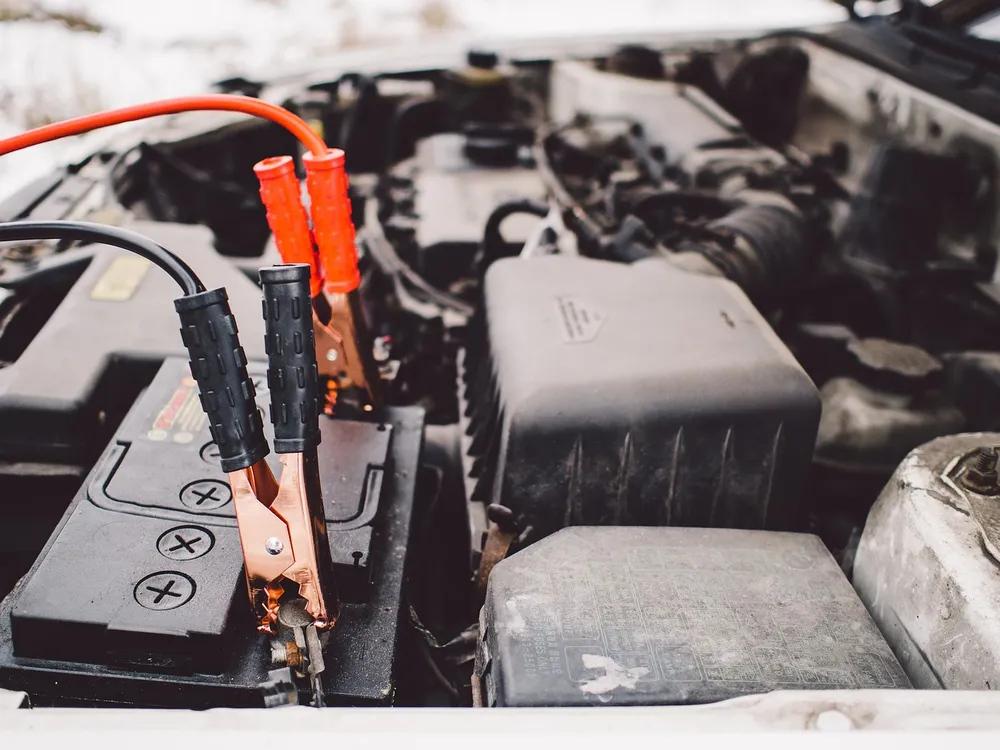
Regardless of how routine jump-starting a car feels, a few habits reduce real risk: keep sparks and open flames (including cigarettes) away from the battery area, avoid leaning directly over the battery while connecting or disconnecting clamps, and wear basic eye protection if you have it, since battery acid or debris can be a hazard separate from the spark/gas issue. Make sure the vehicle is off and, where applicable, any dashboard power-draining accessories are switched off before you start, consistent with our full connection guide.
If you ever smell a strong rotten-egg odor (a sign of a damaged or overcharging battery releasing sulfuric gas) or see a battery that’s visibly swollen, cracked, or leaking, do not attempt to jump-start it with any device. That’s a battery-replacement situation, not a jump-starting one, and connecting clamps to a compromised battery case raises the risk beyond normal jump-starting precautions. If your connections look correct, sparking stays within the normal range described above, and the car still won’t start, the cause is likely elsewhere — see our guide to why a jump starter won’t start the car for how to tell device-side issues from vehicle-side ones.
Frequently Asked Questions
Is any spark from jump starter clamps dangerous?
Not by itself. A brief, small spark exactly when the final clamp completes the circuit is consistent with normal circuit-closure physics. It becomes a real safety concern specifically because of what it could ignite nearby — hydrogen gas from the battery — which is why the standard safety guidance is to make that final connection well away from the battery itself, not because the spark is inherently hazardous in open air.
Why does my jump starter’s manual say to connect the ground clamp away from the battery?
This follows directly from CCOHS safety guidance for battery boosting: keep the final connection at least 30 cm (12 inches) from the battery so that any spark happens away from the hydrogen gas that collects around it, rather than right at the source.
What should I do if the clamps spark when I first connect them?
Stop and disconnect immediately. A spark at the first connection, before the circuit should be complete, usually points to reversed polarity or a clamp touching metal it shouldn’t. Recheck that red is on positive and black is on the correct ground point before reconnecting.
Can I jump-start a car if I smell a strong rotten-egg smell near the battery?
No. That smell can indicate a damaged or overcharging battery releasing gas, and it’s a sign to stop rather than proceed. Ventilate the area, avoid any spark source, and have the battery inspected or replaced instead of jump-starting it.
Does reverse-polarity protection mean I don’t need to check which clamp goes where?
No. Reverse-polarity protection on many jump starters is a safeguard that can prevent the unit from powering a reversed connection, but it’s not a reason to skip checking polarity yourself, and some manual override modes explicitly disable that protection. Always connect red to positive and black to ground correctly as your first step, not as a backup to the device’s protection circuit.
Sources
- Canadian Centre for Occupational Health and Safety (CCOHS), Garages — Lead-Acid Batteries — checked November 2026
- NOCO, GB40 Boost Plus User Guide (official manufacturer manual) — checked November 2026
jumpstarterguides.com Editorial Team. Last updated: November 13, 2026.