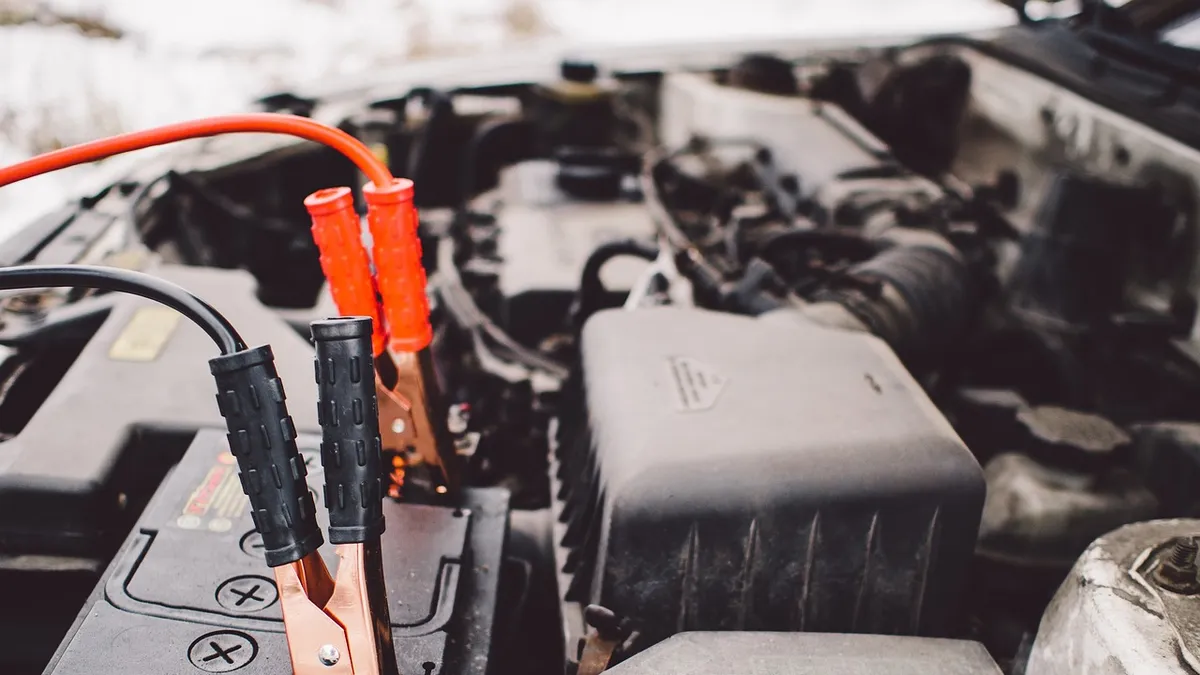
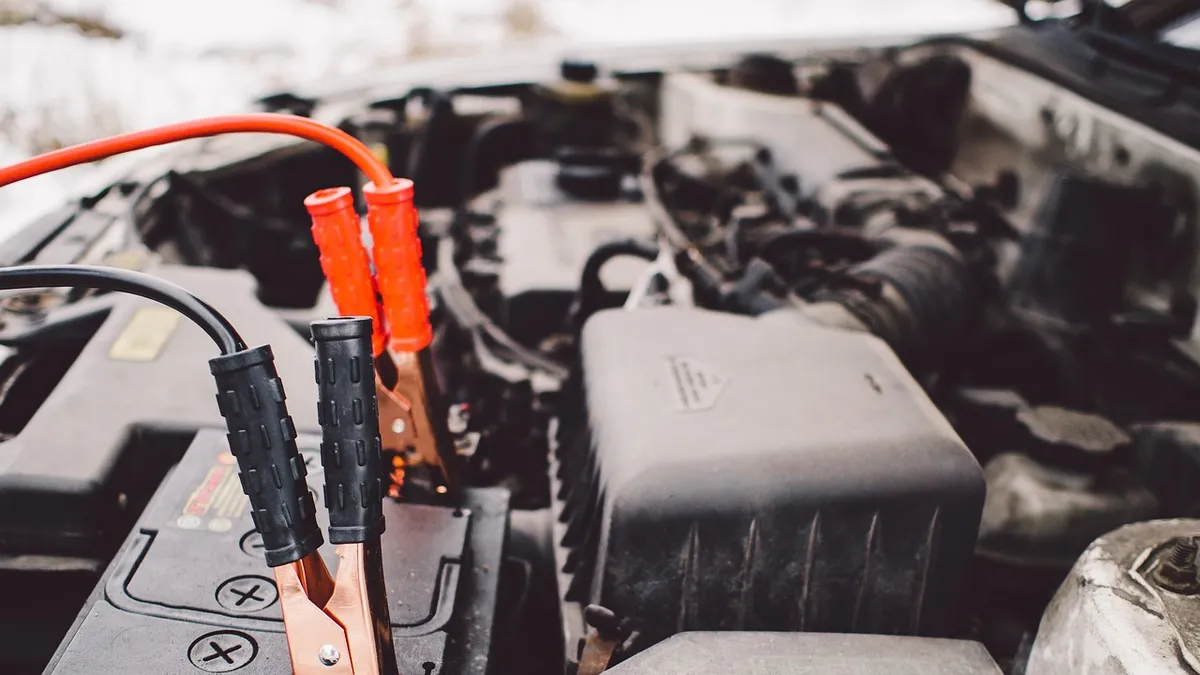
Most portable jump starters claim somewhere between a handful and dozens of jump starts on one charge, and the real number for your unit depends heavily on engine size, outside temperature, and how weak the dead battery is. There is no single reliable figure for “a jump starter” in general — check your own model’s rating, and expect fewer jumps in cold weather or on a big engine.
- The jump-count range you see in marketing is wide because it depends on three things that change every time: engine size, temperature, and the dead battery’s condition.
- A bigger engine and colder weather both draw more cranking current per attempt, which uses up more of the jump starter’s charge per start.
- An old or heavily sulfated battery needs more help (and sometimes more attempts) than a healthy one, even on the same car.
- Manufacturer numbers are usually measured under specific test conditions, so your real-world count will often be lower, especially in cold weather.
- One named example: GOOLOO rates its GP4000 model at 60+ jump starts on a single charge — a figure specific to that one product, not a general rule for all jump starters.
Why the Jump-Count Range Is So Wide
If you’ve compared a few jump starter listings, you’ve probably noticed the claimed number of jump starts per charge varies enormously — from single digits on small units to 60 or more on larger ones. That’s not inconsistency in testing; it reflects three real variables that change every time you use the device, which is also why no single number ever tells the whole story.
If you’re still getting comfortable with the basic connection steps, see our step-by-step guide to using a jump starter correctly first. Each jump start draws a burst of current from the jump starter’s internal battery. How much current that burst requires, and therefore how much of the charge it uses up, depends on the engine, the weather, and the battery being revived. Change any one of those and the number of jumps you’ll get before recharging changes too.
Engine Size: More Displacement Needs More Current
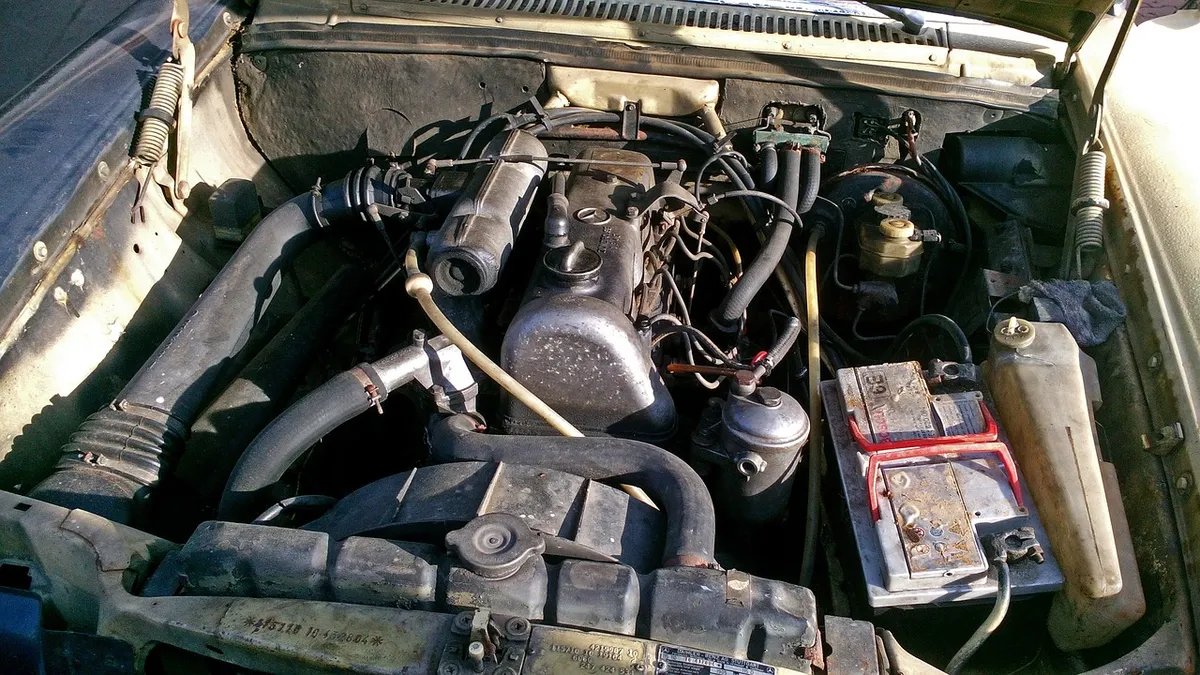
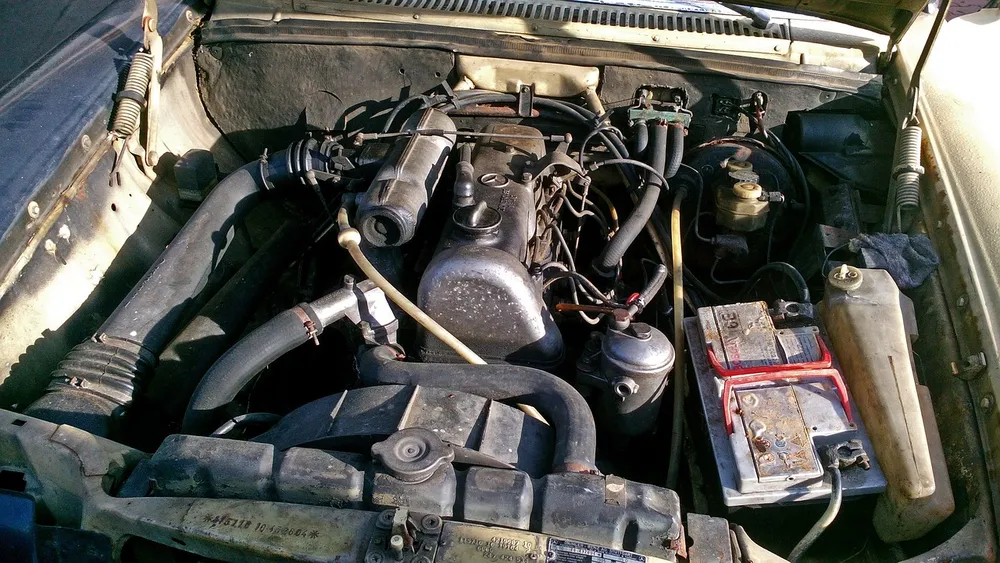
A small four-cylinder car’s starter motor needs far less cranking current to spin the engine over than a V8 truck or a diesel engine does. Diesel engines in particular typically need significantly more cranking current than an equivalent gasoline engine, because of their higher compression. That means the exact same jump starter, at the exact same charge level, will typically deliver more total jump starts on a small sedan than it will on a large truck or diesel — each individual jump on the bigger engine simply costs more of the available charge.
This is also why jump starter listings often list a maximum engine size or displacement the unit is rated for. A unit rated for small-to-midsize gas engines may struggle to repeatedly jump a diesel pickup, even if it can do it once or twice.
Temperature: Cold Pulls More Power, From Both Sides
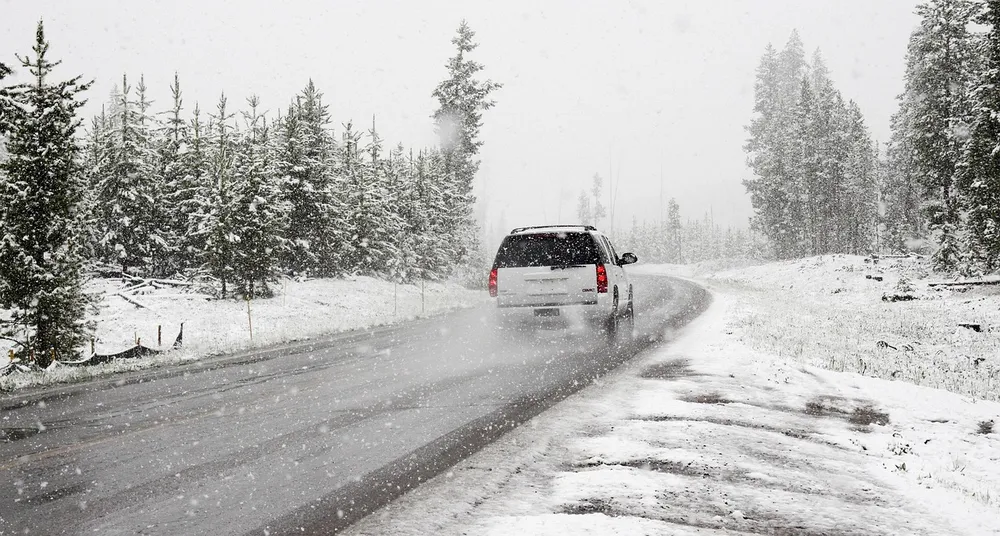
Temperature affects this from two directions at once. A cold engine needs more cranking effort to start than a warm one, because engine oil thickens and resists turning over in the cold. At the same time, the jump starter’s own lithium battery delivers less usable power when it’s cold, for the same reason covered in our guide to storing a jump starter in extreme temperatures. So on a freezing morning, you’re asking a temporarily weaker jump starter to do a harder job — which is exactly why cold-weather jump counts run lower than the same unit’s warm-weather rating.
This is also the reasoning behind the attempt limits built into some units. The NOCO GB40’s official user guide, for example, limits the device to 5 consecutive jump attempts within a 15-minute window before it requires a cool-down period — a safeguard against overheating the unit’s internal components during repeated, back-to-back attempts, which is more likely to happen in exactly the demanding conditions (cold weather, a hard-to-start engine) that use up more charge per attempt.
Battery Condition: A Weak Battery Needs More Help
The third variable is the dead battery itself. A battery that’s simply discharged (left with the lights on overnight, for example) but otherwise healthy usually just needs one good jump. A battery that’s old, heavily sulfated, or failing internally may need a longer jump, a second attempt, or may not respond at all — our guide to a jump starter that won’t hold a charge and our separate guide on whether a jump starter can revive a completely dead (0V) battery cover related angles if that’s the situation you’re in.
Multiple attempts on a stubborn battery use up noticeably more of the jump starter’s charge than one clean jump on a healthy battery, which is another reason the same unit can deliver very different real-world jump counts from one roadside situation to the next.
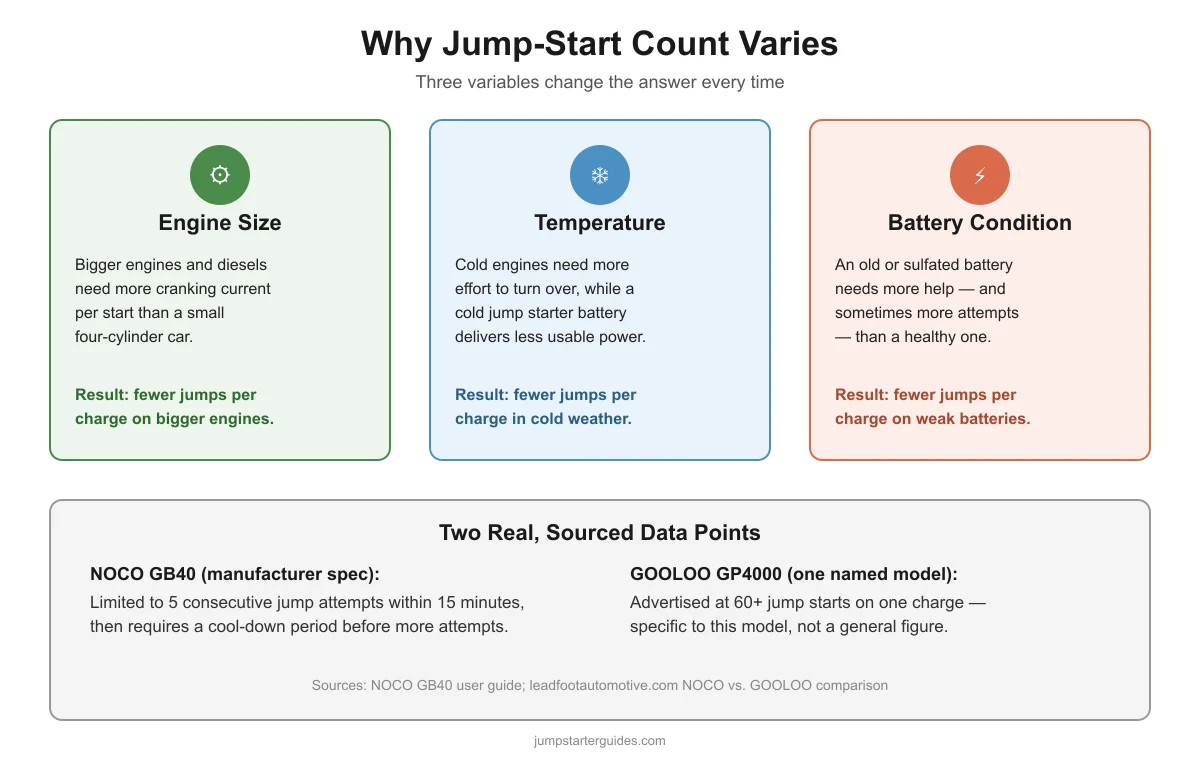
What Factors Affect Jump Count: The Graphic
Here’s the same three-factor explanation as a graphic, since it’s easier to scan than paragraphs when you’re trying to estimate what to expect from your own unit.
Is There a Real Number Worth Trusting?
Treat any jump-count figure you see as a best-case estimate for that specific model under the conditions it was tested in, not a guarantee. One concrete, named example: GOOLOO advertises its GP4000 model as rated for 60+ jump starts on a single charge, according to a comparison of the NOCO GB40 and GOOLOO GP4000. That number applies specifically to the GP4000 and its stated test conditions — it is not a general figure for “jump starters” as a category, and a smaller or older unit, a bigger engine, cold weather, or a weak battery can all pull that real-world number down substantially.
The most useful way to use any manufacturer’s jump-count claim is as a rough ceiling: the best you could reasonably expect under easy conditions (a warm day, a small healthy engine, a merely discharged battery), not a floor you can count on every time.
Frequently Asked Questions
Why do two jump starters with similar specs claim very different jump counts?
Manufacturers test under different conditions and sometimes different definitions of a “jump start,” so the numbers aren’t always directly comparable. Battery capacity, peak amperage rating, and the test engine size used all affect the claimed figure. Compare specs like battery capacity (measured in Wh or mAh) and peak amps rather than the headline jump-count number alone if you’re choosing between two units.
Does using the jump starter to charge a phone reduce how many car jumps it has left?
Yes. Many portable jump starters double as USB power banks, and any power drawn off for charging phones or other devices comes out of the same battery used for jump-starting. If you’re keeping a unit charged for emergency roadside use, it’s worth recharging it after heavy phone-charging use rather than assuming it’s still at full capacity.
Will a jump starter get weaker over its lifespan, even when fully charged?
Yes, gradually. Like any lithium battery, a jump starter’s maximum capacity declines over hundreds of charge cycles and with age, heat exposure, and storage habits. A three-year-old unit at “100%” typically holds less usable charge than it did new, which is part of why our storage guide and the maintenance habits in it matter for getting the most life out of one.
Is it better to attempt several short jumps or one longer one on a stubborn battery?
Follow your unit’s manual rather than guessing. Many jump starters, including the NOCO GB40, build in a limit on consecutive attempts (5 within 15 minutes, in that unit’s case) specifically to prevent overheating from repeated back-to-back tries. If a battery doesn’t respond after a couple of attempts following your manual’s guidance, it may be internally failed rather than just discharged.
Sources
- NOCO, GB40 Boost Plus User Guide (official manufacturer manual, 5-attempts-per-15-minutes limit) — checked November 2026
- Leadfoot Automotive, NOCO GB40 vs. GOOLOO GP4000 comparison (GOOLOO GP4000 60+ jump starts claim, specific to that model) — checked November 2026
jumpstarterguides.com Editorial Team. Last updated: November 13, 2026.