Store a jump starter at 50-80% charge in a climate-controlled spot, not a hot trunk or an unheated garage. Heat speeds up battery aging and can cause swelling in extreme cases; deep cold temporarily saps power and can block charging. Recharge it every 3-6 months even if you never use it.
- Heat is the bigger long-term threat: a trunk can exceed 140°F in summer, which degrades a lithium jump starter’s cells faster than normal use does.
- Cold does not damage a healthy lithium jump starter by itself, but it temporarily reduces usable power and most manuals block charging below about 32°F (0°C).
- Store at 50-80% charge, never at 0% or left at 100% for months at a time.
- Recharge a stored unit every 3-6 months, whether or not you used it.
- Bring a cold unit indoors to warm up before charging it; bring a hot-soaked one indoors before storing it long-term.
Why Temperature Matters for a Jump Starter
Most jump starters sold today use lithium-ion cells, the same battery chemistry in a phone or laptop. Lithium cells are sensitive to heat and cold in different ways. Heat accelerates the chemical aging that slowly reduces how much charge a cell can hold, and in rare extreme cases can cause a damaged or faulty cell to swell or vent. Cold does not cause that kind of permanent chemical damage, but it slows the chemical reaction inside the cell, which temporarily reduces how much current it can deliver and is also why most manufacturers won’t let you charge a cold unit at all until it warms up.
A widely used lithium jump starter, the NOCO GB40’s official user guide, lists an operating range of -20°C to 50°C (-4°F to 122°F), a narrower charging range of 0°C to 40°C (32°F to 104°F), and recommends an average storage temperature of 0°C to 25°C (32°F to 77°F) for the longest battery life, warning never to exceed 80°C (176°F) under any condition. Other brands’ exact numbers vary, so treat this as a representative example and check your own unit’s manual for its specific range.
Storing a Jump Starter in Cold Weather
If a jump starter has been sitting in a cold car or an unheated garage, don’t plug it in to charge right away. Bring it to room temperature first, consistent with the charging-temperature range most manuals specify (commonly starting around 32°F/0°C) — charging a battery that’s still cold can damage the cells over time, which is exactly why that minimum charging temperature exists in the first place. How long that takes depends on how cold it got and the size of the unit; there’s no single manufacturer-confirmed number, so just wait until it feels like room temperature before charging.
Being cold also means a jump starter has less cranking power available than it would at room temperature, even at the same charge percentage. If you keep one in a vehicle through winter for emergencies, that’s a trade-off worth knowing: it’s ready to grab, but it may perform weaker on the coldest mornings than it tested on a mild day. A fully charged unit kept at room temperature is more reliable than a partially charged one left in a freezing trunk.

Storing a Jump Starter in Hot Weather
Heat is the more serious long-term risk. According to Battery Tender’s guidance on portable jump starter maintenance, a car’s interior or trunk can exceed 140°F (60°C) in extreme summer conditions, and lithium cells degrade measurably faster at raised temperatures than they would in climate-controlled storage. That faster aging is a gradual loss of capacity, not a single dramatic failure, but in rare cases a damaged or defective lithium cell exposed to extreme, sustained heat can swell or vent (release pressure), which is why manuals set a hard maximum temperature and warn to stop using any unit that becomes unusually warm.
The practical takeaway: don’t leave a jump starter in a closed vehicle through a hot summer as a long-term storage spot, even though it’s a convenient place to keep one for emergencies. If you want it in the car for roadside use, that’s reasonable for day-to-day driving, but for weeks or months of storage, a climate-controlled space (a hall closet, an interior garage shelf, a mudroom) beats a trunk.

The Storage Charge and Recharge Table
Beyond temperature, how full the battery is when you put it away also affects how long it lasts. Here is the maintenance routine Battery Tender recommends for portable jump starters, shown as a graphic and then as a table.
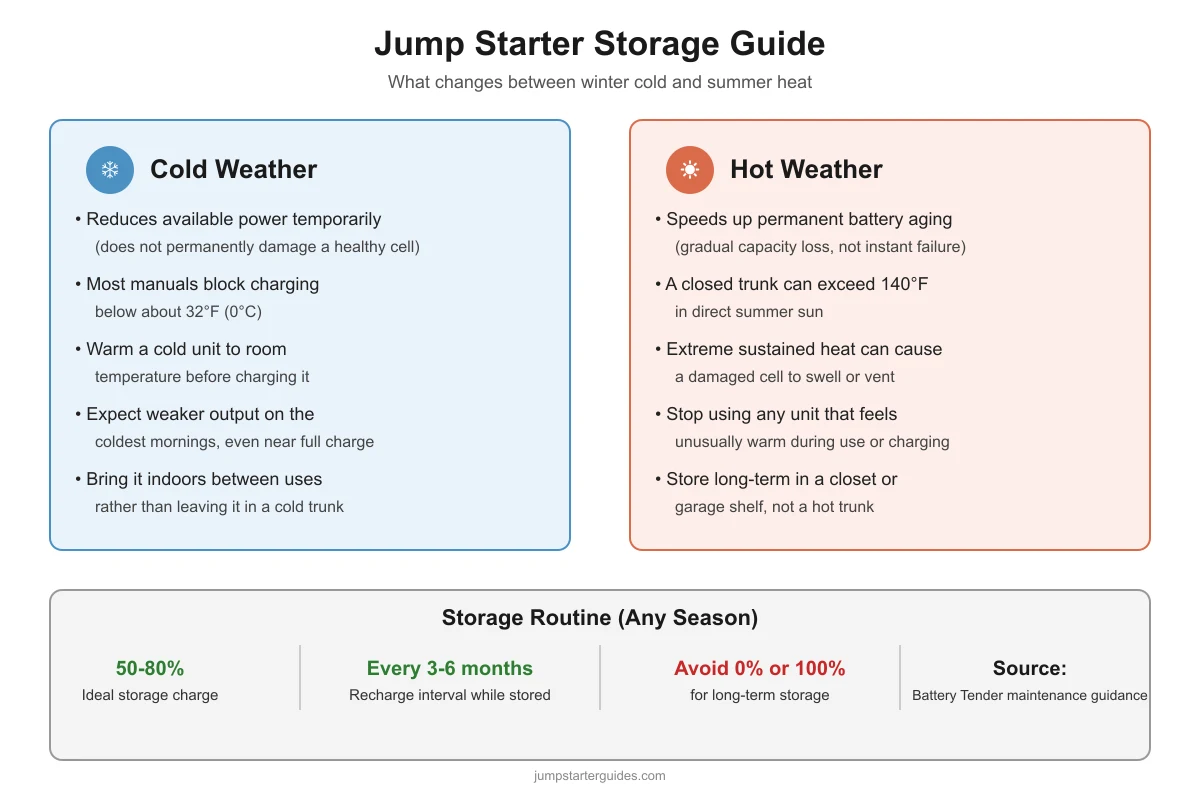
| Storage factor | Recommendation | Why |
|---|---|---|
| Charge level | 50-80% of full capacity | Storing at 100% or at 0% both degrade lithium cells faster than a mid-range charge. |
| Recharge interval | Every 3-6 months | A stored unit slowly self-discharges; recharging on a schedule keeps it in the safe 50-80% band and ready to use. |
| Location (hot season) | Climate-controlled space, not a trunk or closed car | Vehicle interiors can exceed 140°F in summer, accelerating cell aging. |
| Location (cold season) | Indoors or insulated space when possible | Cold temporarily cuts power output and most units refuse to charge below about 32°F. |
Where to Keep a Jump Starter Day to Day
Good storage habits only matter if the unit also gets used correctly when you need it; if you’re not confident on the connection order and safety basics, our step-by-step guide to using a jump starter correctly covers that separately. For a unit you actually plan to use in an emergency, the trunk is a reasonable compromise between convenience and ideal storage conditions — just don’t treat the car as its permanent home for months on end without ever checking on it. A simple routine works well: keep it in the vehicle for accessibility, but every few months bring it inside, check the charge level, top it up if it’s below the 50-80% range, and put it back. That single habit addresses both the temperature exposure and the recharge-interval guidance above.
If you’re storing a spare unit purely as a backup (in a closet, garage shelf, or utility room rather than the car), you get the best of both: a stable temperature and an easy reminder spot to check every few months. Whichever way you store it, label a reminder on your phone or calendar for the recharge interval — it’s the step most people forget, and a jump starter that’s been ignored for a year is more likely to show the kind of charge-holding problems covered in our guide to a jump starter that won’t hold a charge.
Frequently Asked Questions
Is it safe to leave a jump starter in a hot car for a road trip?
For the length of a single trip, yes — that’s exactly the kind of situation a portable jump starter is designed for. The heat concern is about long-term storage, not occasional short exposure. The problem is leaving it in a hot trunk as its permanent home for weeks or months, which is when accelerated aging becomes measurable.
Can cold weather permanently damage a jump starter?
Cold by itself does not cause the same kind of permanent cell damage that sustained heat can. It mainly reduces how much power the unit can deliver until it warms up, and most manuals block charging below about 32°F (0°C) to protect the battery. Let a cold unit reach room temperature before charging it.
What charge percentage should I leave my jump starter at in storage?
Aim for 50-80% of full capacity. Storing it fully charged (100%) or fully dead (0%) for long periods both shorten lithium battery life compared to a mid-range charge, based on Battery Tender’s maintenance guidance for these devices.
How often do I need to recharge a jump starter that’s just sitting in storage?
Every 3-6 months, even if you never use it. Lithium batteries slowly self-discharge over time, and recharging on that schedule keeps the cells in the healthier 50-80% range instead of drifting down toward empty.
Why does my jump starter feel weaker on cold mornings?
That’s normal, not a fault. Cold temporarily lowers how much current a lithium battery can deliver, even at the same charge percentage it would show on a warm day. If the unit also won’t charge at all when cold, check the ideas in our guide to how many jump starts you get on one charge for how temperature affects total capacity, or bring it inside to warm up first.
Sources
- NOCO, GB40 Boost Plus User Guide (official manufacturer manual) — checked November 2026
- Battery Tender (Deltran), Portable Jump Starter Maintenance Tips — checked November 2026
jumpstarterguides.com Editorial Team. Last updated: November 13, 2026.

One thought on “How to Store a Jump Starter in Extreme Heat or Cold”