Usually not, at least not without extra steps. Most portable jump starters include a safety circuit that needs to detect a minimum battery voltage — about 2V on one tested manufacturer’s model — before it will engage. A battery that reads close to 0V often won’t be detected at all, which is why the jump starter appears to do nothing until you use a special override mode described in its manual.
- Jump starters aren’t designed to blindly push power into anything — they check for a minimum voltage first, as a safety measure.
- On one tested model, that detection floor is about 2V; below it, the ready/Boost light stays off even with the clamps connected correctly.
- A “Manual Override” mode exists on some units specifically to attempt a jump below the normal detection floor — but it works by disabling the device’s main safety protections, not by adding power.
- A battery that’s merely discharged (but otherwise healthy) is a very different situation from one that’s internally failed or shorted — only one of those can realistically be helped by a jump starter.
- There’s no universal “this exact voltage means the battery is dead forever” number — the physical signs matter more than one reading.
Why Won’t a Jump Starter Respond to a Truly Dead Battery?
It comes down to how the jump starter protects itself and you. Before sending any power to the clamps, these devices check whether a battery is actually connected and what voltage it’s reading. On one widely used jump starter’s official manual, that check requires at least roughly 2 volts from a 12-volt lead-acid battery — if the voltage is lower than that, the unit treats it as “no battery detected” rather than attempting a jump, and the ready or Boost indicator light stays off even though the clamps are connected the right way.
This isn’t a flaw — it’s intentional. A device that will push full cranking current into absolutely anything, regardless of what’s on the other end, is a much bigger safety risk than one that double-checks first.
What Is “Manual Override,” and Should You Use It?
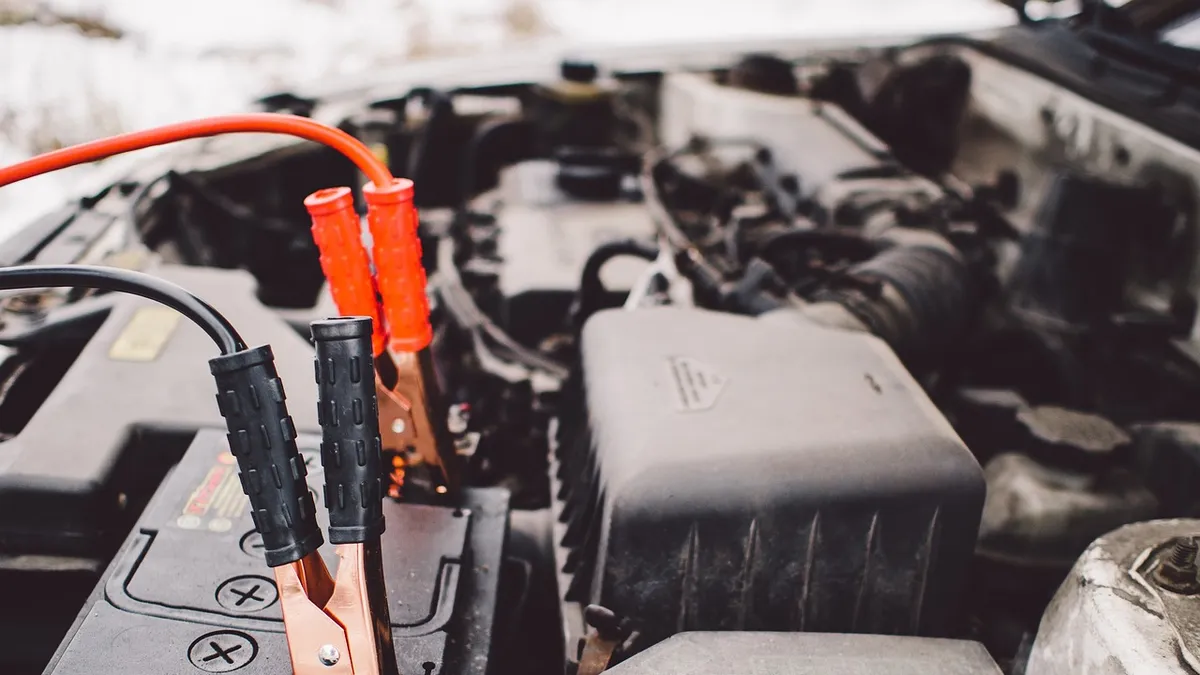
Some jump starters include a Manual Override mode specifically for situations where the battery reads below the normal detection floor. According to the manufacturer’s own manual for one such model, switching to Manual Override disables both of the unit’s main safety protections at once: reverse-polarity protection and spark-proof protection. In other words, it doesn’t add power or lower the bar in a safe way — it removes the safety nets that normally stop you from connecting the clamps backward or creating a spark-producing short.
That tradeoff matters. With Manual Override active, a mistake that the unit would normally catch and block — wrong polarity, a loose clamp touching the wrong metal — can go through uncaught. If you use this mode at all, follow your unit’s manual exactly, double- and triple-check clamp polarity before and after connecting, and treat it as a last resort rather than a routine setting. For the full standard connection procedure (which still applies even in override mode), see how to use a jump starter correctly.
Discharged-But-Healthy vs. Internally Failed: What’s the Real Difference?
This is the distinction that actually matters, and it’s more useful than chasing one exact voltage number. A battery that’s simply discharged — drained by a light left on overnight, a parasitic draw, or just sitting unused for a long time — is usually still mechanically and chemically sound inside. A battery that’s internally failed has actual damage: a shorted cell, a broken internal connection, or sulfation so severe it can no longer hold a usable charge.
Battery maker Interstate Batteries’ own car-battery care guide backs up the physical side of this check: it describes cracks in the battery casing, wetness at the terminals, or bubbling liquid as signs of a leaking battery, and treats that as a case for professional attention rather than a simple recharge. Those are the same physical red flags listed in the table below.
| Sign | Discharged but Healthy | Internally Failed / Shorted |
|---|---|---|
| Voltage reading | Low, may read below the jump starter’s detection floor | Often very low or erratic; may not rise meaningfully even on a charger |
| Response to jump starter | May respond, sometimes only after using Manual Override, per the unit’s manual | May not respond even to Manual Override — the fault is inside the battery, not the connection |
| Physical condition | No swelling, cracking, or leaking | May be swollen, cracked, leaking, or smell strongly of sulfur |
| Behavior after a successful jump | Holds a charge normally once driven for a while | Dies again almost immediately, even after driving |
| What actually fixes it | A jump start, followed by driving to recharge, or a battery charger | Nothing — the battery needs to be replaced |
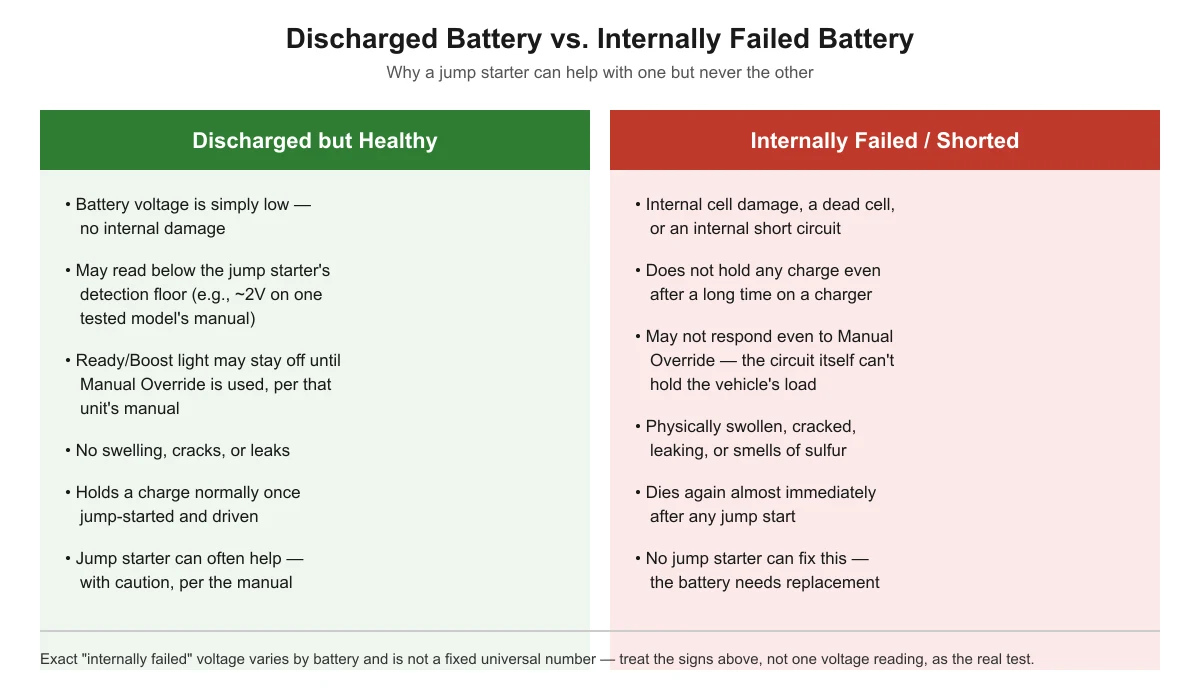
There isn’t a single sourced voltage number that reliably separates “discharged” from “internally failed” across every battery — it varies by battery size, age, and how it failed. If a battery shows any of the physical failure signs in the table above, or won’t respond even to a correctly used Manual Override, treat it as failed rather than continuing to try new approaches. For more on diagnosing a no-start situation generally, see jump starter won’t start the car.

What Should You Actually Do With a 0V-Reading Battery?
Start by looking for the physical failure signs above — swelling, cracking, leaking, or a strong sulfur smell mean the battery needs replacement, full stop, regardless of what any jump starter can do. If the battery looks physically normal, check your jump starter’s manual for whether it has a Manual Override or similar mode for low-voltage detection, and follow its exact instructions if you decide to use it.
If the battery responds and holds a charge normally afterward, it was likely just deeply discharged. If it dies again almost immediately or never responds even to override mode, that points to internal failure, and the next step is replacement or a professional battery test — not repeated jump-start attempts.
Safety Notes
Never attempt to jump a battery that is visibly swollen, cracked, or leaking — these are signs of internal damage that can make the battery unsafe to work on, independent of any voltage reading. If you do use a Manual Override feature, double-check clamp polarity carefully before and after connecting, since that mode specifically removes the protection that would otherwise catch a reversed connection. Work in a well-ventilated area and avoid letting the clamps touch each other, since a dead short between them can produce sparks near a battery that may be venting gas.
Frequently Asked Questions
Why does my jump starter’s light stay off even though the clamps are connected correctly?
On at least one tested model, the ready/Boost light stays off whenever the connected battery’s voltage is below the unit’s detection floor — around 2V on that model. The jump starter isn’t broken; it simply can’t detect a battery to work with at that voltage.
Is Manual Override safe to use regularly?
No. According to the manufacturer’s manual for one jump starter with this feature, Manual Override disables both reverse-polarity and spark-proof protection. Use it only as a deliberate, careful last resort, never as a routine setting, and follow your unit’s manual exactly.
How can I tell if my battery is just discharged or actually dead?
Check for physical signs first — swelling, cracking, leaking, or a sulfur smell mean internal failure. If the battery looks normal, responds to a jump, and holds a charge afterward, it was likely just discharged.
Can any jump starter eventually revive a battery that reads 0V?
Not if the battery is internally failed — no jump starter can fix a shorted cell or physical damage inside the battery. If it’s only discharged, some units can help using a low-voltage override mode, per their own manual.
What should I do if the battery won’t respond even to Manual Override?
Treat that as a sign of internal failure rather than trying repeated jump attempts. The next step is a professional battery test or replacement, not more attempts with the same or a different jump starter.
Sources
- NOCO GB40 Official User Guide (minimum detection voltage of about 2V; Manual Override disabling reverse-polarity and spark-proof protection)
- Interstate Batteries – How to Maintain a Car Battery (physical signs of a leaking or damaged battery: cracks in the casing, wetness at the terminal, bubbling liquid)
By jumpstarterguides.com Editorial Team. Last updated: November 13, 2026.
3 thoughts on “Can a Jump Starter Start a 0V Dead Car Battery?”