A jump starter that won’t hold a charge is usually suffering from accelerated lithium-cell aging caused by heat, being stored at 100% charge, or both. Keeping it at a partial charge (roughly 50-80%), recharging it every 3-6 months in storage, and avoiding hot storage spots like a car trunk all slow this down. If it still won’t hold a useful charge after that, the cell itself has likely reached the end of its useful life.
- Heat is the single biggest factor in how fast a lithium jump starter loses capacity over time.
- Storing the unit fully charged (100%) accelerates degradation compared to storing it partially charged.
- A storage charge level of roughly 50-80%, with a recharge every 3-6 months, is the manufacturer-sourced sweet spot for longevity.
- A unit that won’t reach a full charge anymore, or that dies after one jump when it used to handle several, has likely reached end-of-life rather than a fixable fault.
Why Do Lithium Jump Starters Lose Capacity Over Time?
Every lithium battery loses some usable capacity as it ages — that’s normal. What varies a lot is how fast that happens, and two storage habits make the biggest difference for a jump starter that mostly sits unused between emergencies.
First, heat speeds up cell aging more than almost any other factor. According to Battery Tender (Deltran), a company that makes battery chargers and maintainers, storing a battery pack in a hot environment — a car trunk or glovebox in summer can run hotter than the engine bay itself — measurably accelerates how fast a lithium cell degrades. If your jump starter lives in your vehicle year-round, that’s working against it every summer.
Second, how full the battery is while it’s sitting unused matters. Battery Tender’s guidance on portable jump starter maintenance recommends keeping a stored lithium pack at roughly 50% to 80% of full capacity rather than topping it all the way to 100% before putting it away. A cell held at full charge for extended periods ages faster than one kept at a moderate partial charge. This is the opposite of the instinct most people have — topping off before storing it feels responsible, but it isn’t the best long-term choice for a unit that will sit for months.
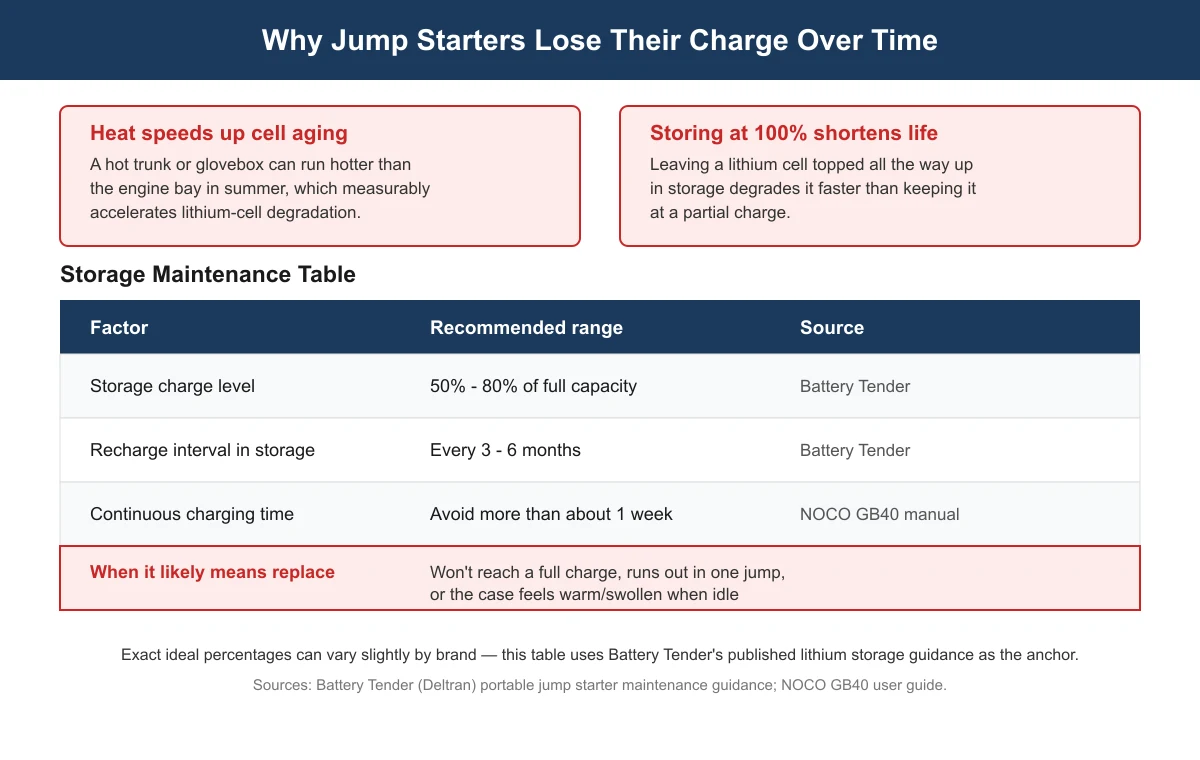
Storage Maintenance Table
| What to check | Recommended practice | Why |
|---|---|---|
| Storage charge level | About 50-80% of full capacity | Reduces the aging effect of sitting at a full charge for long periods |
| Recharge interval while stored | Every 3-6 months | Prevents the cell from sitting too depleted for too long |
| Storage location | A moderate, stable temperature, not a hot trunk or glovebox | Heat is the biggest accelerant of lithium-cell capacity loss |
| Continuous charging time | Avoid charging for more than about a week straight | Manufacturer guidance warns extended continuous charging can shorten battery life |
Exact ideal percentages can vary slightly by brand — treat the 50-80% figure as a well-sourced anchor rather than a hard rule for every single model, and check your own unit’s manual if it specifies something different.
Where You Store It Matters as Much as How Full It Is
A jump starter kept in a hot vehicle year-round is fighting both risk factors at once if it’s also stored fully charged. If your jump starter mostly lives in your car, see our guide to storing a jump starter in extreme heat or cold for the manufacturer-sourced temperature ranges and what to do in both seasonal extremes.
When Does This Mean It’s Time to Replace the Unit?
Some capacity loss over the years is expected and not a sign anything is wrong. These signs point to a unit that has reached the end of its useful life rather than one that just needs better storage habits going forward:
- It no longer reaches a full charge even after a complete charging cycle on a known-good cable.
- It used to handle several jump attempts on one charge and now dies after a single one.
- The case feels unusually warm or appears swollen while just sitting idle, not charging or in use.
- It loses most of its charge within days of a full charge, even with no use in between.
If you’re trying to figure out how many jumps a healthy unit should give you before assuming it’s degraded, see our guide to how many jump starts you can get on one charge — engine size, temperature, and battery age all affect that number even on a perfectly healthy jump starter, so a lower-than-expected count isn’t automatically a sign of degradation.
Is This the Same Problem as a Jump Starter That Won’t Charge at All?
No — these are two different problems. A unit that won’t hold a charge does charge, but loses that charge unusually fast in storage or use. A unit that won’t charge at all shows no charging indicator no matter how long it’s connected. If your unit falls into the second category, see our separate guide to step-by-step fixes for a jump starter that’s not charging.
Good Habits Start With Correct Use
Storage habits aren’t the only thing that affects how long a jump starter’s charge lasts. Using the clamps correctly, minimizing unnecessary repeated attempts, and letting the unit cool when it signals an overheat condition all reduce the strain placed on the cell during actual use. If you want the full step-by-step on connecting, disconnecting, and operating a jump starter safely, see our pillar guide to using a jump starter correctly.
Frequently Asked Questions
Is it bad to leave a jump starter plugged in all the time?
Yes, for two reasons. Manufacturer guidance specifically warns against charging continuously for more than about a week, and keeping a lithium cell topped at 100% for extended periods accelerates capacity loss compared to storing it at a partial charge.
How often should I recharge a jump starter that’s just sitting in storage?
About every 3 to 6 months, per Battery Tender’s published guidance on portable jump starter maintenance. Going much longer than that without a recharge risks the cell sitting too depleted for too long.
Does storing a jump starter in a hot car really make a measurable difference?
Yes. Heat is the single biggest accelerant of lithium-cell aging according to Battery Tender’s maintenance guidance, and a trunk or glovebox in direct sun can exceed engine-bay temperatures in some vehicles.
My jump starter is only two years old but barely holds a charge. Is that normal?
Not necessarily — that’s faster capacity loss than you’d expect from normal aging alone, and it’s worth reviewing how the unit has been stored. If it’s regularly been left at 100% in a hot vehicle, that combination is the most likely explanation, though a genuinely defective cell is also possible.
Will keeping it at 50-80% charge instead of 100% actually extend its life?
Based on published lithium-battery maintenance guidance, yes — storing at a partial charge rather than full is a well-established way to slow capacity loss in a battery that sits unused for long stretches between uses, which describes how most people actually use a jump starter.
Sources
- Battery Tender (Deltran), “Portable Jump Starter Maintenance Tips” — storage charge range (50-80%), recharge interval (3-6 months), and heat’s effect on lithium-cell aging.
- NOCO, GB40 Boost Plus User Guide and Warranty (manufacturer manual) — guidance against charging continuously for more than about a week.
By jumpstarterguides.com Editorial Team. Last updated: November 13, 2026.